

Forget the old advice to "just post more." That's a recipe for burnout, not bookings. Real success in hotel social media marketing today isn't about how much you post, but how much impact you make. We're going to get straight to what actually works, shifting away from being a content factory and toward creating genuine experiences that drive revenue.
Moving Beyond Likes to Direct Bookings
In today's competitive market, a winning hotel social media strategy acts less like a megaphone shouting deals and more like an exclusive travel guide. It's about showing potential guests the unique experiences that only you can offer. The goal has fundamentally changed from racking up vanity metrics like likes and followers to generating tangible business results—specifically, direct bookings that pad your bottom line.
This means every post, every story, and every collaboration needs a clear purpose. You're not just showcasing a room; you're selling the feeling of waking up in that room with a view. Instead of just listing your amenities, you're illustrating the lifestyle your hotel makes possible. This approach requires a much deeper understanding of what actually motivates a modern traveler to click that "Book Now" button.
The Evolution of Hotel Social Media Strategy
To truly grasp this shift, it helps to see where we've been and where we need to go. The social media playbook from five years ago is gathering dust for a reason.
| Outdated Tactic | Modern Strategy That Drives Bookings |
|---|---|
| Posting blurry, low-effort photos. | Investing in high-quality, professional, and user-generated visuals. |
| Using generic hashtags like #hotel. | Researching and using niche, location-specific, and trending hashtags. |
| Focusing solely on follower count. | Prioritizing engagement rate, website clicks, and direct bookings. |
| Broadcasting one-way promotional messages. | Creating a two-way dialogue with guests and building a community. |
| Ignoring negative comments or reviews. | Responding to all feedback promptly and professionally to build trust. |
| Posting sporadically with no plan. | Sticking to a consistent content calendar with strategic themes. |
| A "one-size-fits-all" approach. | Tailoring content specifically for each platform and audience segment. |
This evolution is all about moving from a passive, promotional mindset to an active, experience-driven one that builds relationships and delivers measurable ROI.
The Modern Traveler's Journey
The path from inspiration to booking is no longer a straight line. It’s a winding journey through social feeds, where travelers discover, dream, and validate their choices. A recent look at hospitality trends shows just how critical this journey is. In 2025, global social media ad spending is projected to hit a staggering $276.72 billion, and the hospitality industry is a huge part of that.
What's driving this investment? Powerful consumer behavior. An incredible 61% of travelers have booked a hotel after seeing it on Instagram, and 41% have finalized bookings through links shared by influencers.
This simple infographic breaks down how a results-focused strategy should be structured.
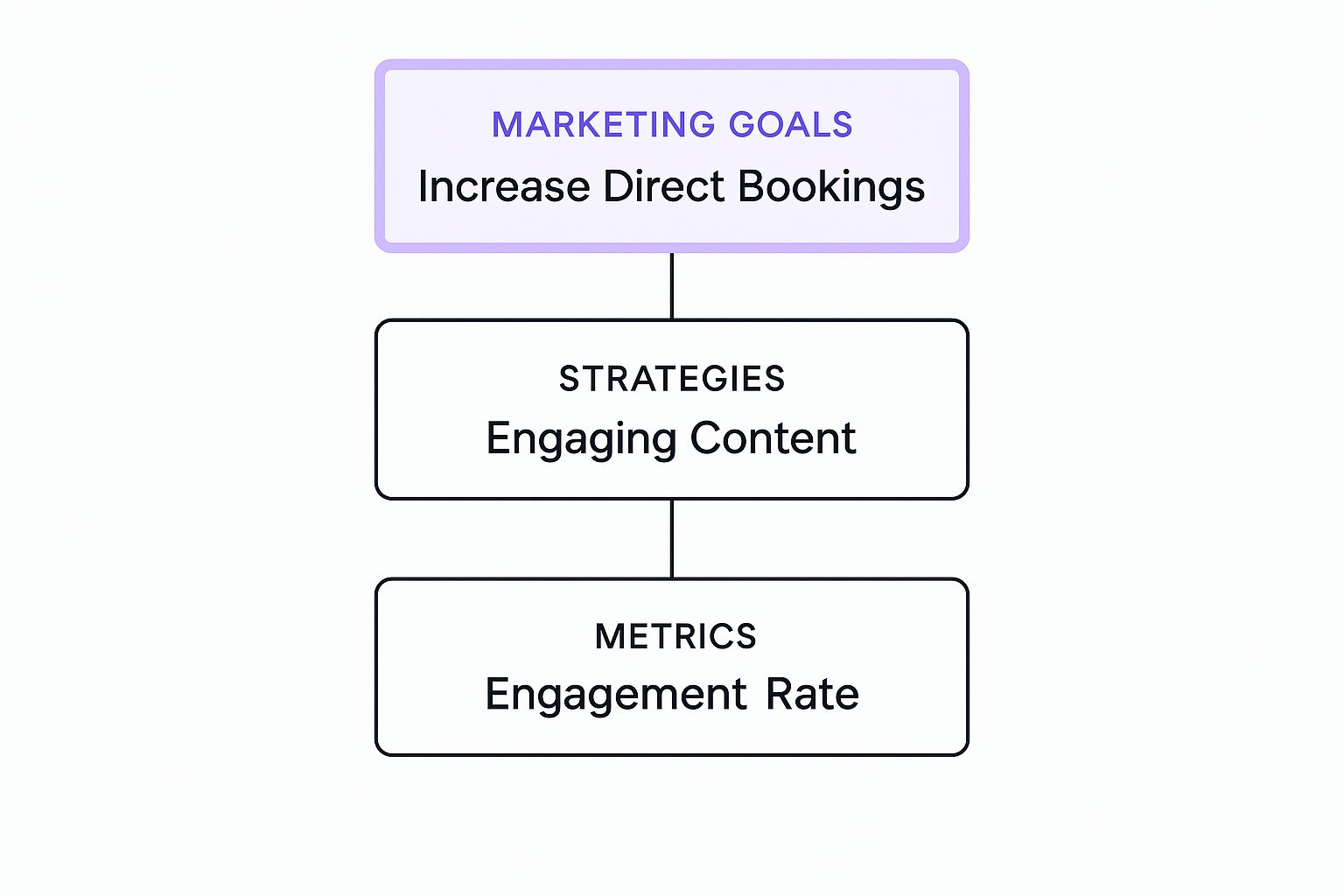
As you can see, everything starts with the goal of increasing direct bookings. This is achieved through specific strategies and engaging content, and its success is measured by metrics that actually matter to your business.
The Power of Authentic Content
To build that crucial connection with potential guests, hotels are increasingly relying on user-generated content (UGC). Content created by real guests and talented creators simply hits different. It feels more authentic than polished, corporate ads and provides the social proof that people crave before making a purchase. It builds a level of trust that branded advertising can’t buy.
The core idea is simple: Show, don't just tell. Instead of saying your hotel is relaxing, show a guest-created Reel of someone enjoying a serene morning coffee on their private balcony.
For content creators, this shift presents a massive opportunity. Hotels are actively looking for partners who can produce high-quality, authentic content that gets results. If you're a creator interested in this booming field, understanding this dynamic is the first step. You might want to check out our guide on how to start a UGC agency. The new model is built on partnerships that deliver real, trackable value—moving far beyond the old-school trade of a free stay for a few posts.
Choosing Platforms Where Your Guests Actually Book
Trying to be everywhere on social media is a classic mistake. It stretches your team too thin and leads to a bland, forgettable presence across the board. The real secret to a powerful hotel social media marketing strategy isn't about being on every single platform; it's about making a significant impact on the right ones.
Think of it this way: each social platform is like a different kind of travel publication. One is a glossy magazine for visual inspiration, another is a collection of raw, user-generated stories, and a third is a community newsletter with exclusive deals. You wouldn't run the same ad in all three, right? So don't treat them the same in your social strategy. The trick is to align the unique culture of each platform with what makes your hotel special.
This goes way beyond just looking at user counts. You need to get inside the head of a traveler using each app. Are they just starting to dream about a trip? Are they actively planning the details? Or are they ready to pull out their credit card? Nailing this down is what separates a strategy that just gets likes from one that actually gets bookings.
Instagram: The Visual Discovery Engine
Instagram is, without a doubt, the king of travel inspiration. It's where future guests go to daydream and discover their next destination. For your hotel, this is your digital lookbook—the place to tell a visual story that plants the first seed of desire.
But success here isn't about posting sterile, professional shots of empty rooms. It’s about selling the experience that surrounds those rooms.
- Immersive Reels: Create snappy, dynamic videos that capture the feeling of a stay. Imagine a 15-second clip that takes a viewer from checking in, to clinking glasses at the rooftop bar, to waking up to a stunning view.
- Aesthetic-Driven Carousels: Use carousels to walk people through a story. A "Perfect Day at Our Hotel" carousel could show off morning coffee on the balcony, a poolside afternoon, and evening turndown service, with each slide building on the last.
- Geo-Tagged Stories: Don't forget to use location tags in your Stories. This is how you catch people who are already searching for things to do in your city, turning local curiosity into a direct path to your profile.
TikTok: The Home of Authentic Moments
TikTok has exploded as a travel planning tool, especially for younger demographics like Gen Z, who will literally plan entire trips around a viral video. The currency on TikTok isn't perfection; it's authenticity. This is your chance to pull back the curtain and show off your hotel's true personality.
You need to think more like a creator than a marketer here. The content that performs best often feels unscripted and real, giving viewers a behind-the-scenes peek that builds trust and gets them excited. Let your staff be the stars—have your concierge share their favorite local coffee shop or film a "day in the life" of your head chef.
The key to TikTok is realizing users don't want a sales pitch. They want to be entertained and learn something new. A viral video of your bartender's secret cocktail recipe will do more for your brand than a traditional ad because it provides value first.
Facebook: The Community and Conversion Hub
While Instagram and TikTok are brilliant for catching attention at the top of the funnel, Facebook is your workhorse for nurturing that interest and driving actual bookings. The audience here often skews a bit older, which can mean travelers with more disposable income who are further along in the planning process.
This is where you build a community and put Facebook's powerful advertising tools to work. The data backs this up: a staggering 80% of travel marketers use Facebook for their paid ad campaigns to tap into its massive reach. Even more telling, 45% of hotel guests say they are likely to book a promotion they see on social media, showing a clear line from a targeted ad to revenue. If you want to dive deeper into the data, you can see how social media's role in the hospitality industry breaks down across different platforms.
Use Facebook to run laser-focused ads for seasonal packages, promote events at your hotel, and re-engage past guests to keep them coming back.
Crafting Content That Makes People Need to Book
Let's be blunt: high-quality photos of your hotel rooms aren't a strategy anymore. They're table stakes. To actually stop someone from scrolling, your hotel social media marketing has to do more than just show off your space. It needs to tell a story that sparks a genuine feeling, making a potential guest see your hotel as the solution to their travel dreams.
The goal is to shift from "look at our pool" to "imagine yourself here, finally relaxing after a long day of exploring the city." That's the pivot. It's the difference between being another post in a crowded feed and being the reason someone starts planning their next trip.
From Features to Feelings: The Secret to Irresistible Content
Every hotel has beds, a lobby, and maybe a restaurant. Those are just features. What travelers actually buy are benefits—the feelings those features provide. Your content's most important job is to translate those features into irresistible benefits.
Think about it this way:
- Feature: "We have king-sized beds."
- Benefit-Driven Story: Show a Reel of someone sinking into those crisp sheets after a long travel day, waking up completely refreshed and ready to seize the day. The hero isn't the bed; it's the incredible sleep.
- Feature: "Our hotel is downtown."
- Benefit-Driven Story: Create a carousel post that's an "insider's guide" to the neighborhood. Position your hotel as the perfect launchpad, with the best hidden coffee shop, street art, and speakeasy all just steps from your door.
- Feature: "We offer room service."
- Benefit-Driven Story: Post a photo of a guest indulging in a decadent breakfast in bed. Frame it not as a menu item, but as the ultimate vacation treat they absolutely deserve.
This isn't about selling inventory. It's about selling an experience—a slice of an aspirational lifestyle, even if it's just for a weekend.
The Right Content Formats to Drive Action
Relying on a single content format is like trying to build a house with only a hammer. You need a full toolbox. To create that sense of desire, you need to match the format to the story you're telling. A fast-paced video can convey energy and excitement, while a detailed guide establishes your authority as a local expert.
The most powerful content doesn't just interrupt someone's feed; it becomes a valuable part of it. It educates, entertains, or inspires, turning your hotel's profile into a destination in itself.
Think of your content as an ecosystem. Social media is brilliant for sparking that initial "wow" moment. From there, you can guide interested travelers to more in-depth resources on your website. Making sure your social media and website work together is crucial, and you can dive deeper into that with our guide to travel SEO.
High-Impact Content Examples That Actually Work
Ready to go beyond the basics? Here are three powerful content types that consistently deliver results for modern hotels.
-
Experience-First Video Shorts: Forget the slow, boring pans across empty rooms. Create dynamic 15-30 second Reels or TikToks that drop the viewer right into the middle of an experience. Show the clinking of glasses on your rooftop bar at sunset, the steam rising from a fresh coffee on a private balcony, or a time-lapse of the city lights coming alive from a suite window. These clips sell a feeling, not a floor plan.
-
'Local Insider' Guides: This is how you become indispensable. Position your hotel as the key to unlocking an authentic local experience. Create content that shines a spotlight on your local partners and hidden gems. Interview the owner of that amazing bakery down the street, create a map of the best photo spots near your property, or have your concierge share their top three "can't-miss" local secrets. It provides massive value and builds incredible trust.
-
Humanizing Behind-the-Scenes Content: Pull back the curtain and introduce the real people who make your hotel special. A "day in the life" of your head chef, a quick chat with the gardener who tends to your beautiful courtyard, or even a simple welcome message from your general manager helps to humanize your brand. People connect with people, and this kind of content fosters a powerful sense of community and loyalty that photos of empty rooms never will.
The ROI-Driven Influencer Partnership Playbook
Let's be honest. The old way of doing influencer marketing—offering a free weekend stay for a couple of blurry Instagram posts—is dead. A modern, profitable hotel social media marketing strategy treats these partnerships as a serious business investment, not a casual perk. The game has completely shifted from chasing fuzzy "exposure" to engineering real, measurable conversions.
This new playbook is all about precision. It’s about finding creators whose followers aren't just a big number, but are the exact people who would actually book a room at your hotel. True success means digging deeper than surface-level metrics to build collaborations that directly pad your bottom line.
Vetting Creators for Real Impact
The single most important step is picking the right partners. A creator with a million followers is totally useless to your boutique hotel if their audience is mostly teenagers with no travel budget. On the flip side, a micro-influencer with 10,000 highly engaged followers who genuinely trust their travel advice can send a flood of new bookings your way.
Your vetting process needs to be tough and data-driven. Here's what to look for in a valuable partner:
- Audience Alignment: Always ask for their media kit and look at the audience demographics. Do their followers' age, location, and income line up with your ideal guest?
- Genuine Engagement: Don't get star-struck by a huge follower count. Do the math yourself and calculate their average engagement rate (likes + comments ÷ followers). A healthy rate is around 2-3%; anything consistently below 1% is a massive red flag that could signal fake followers or a bored community.
- Content Quality and Niche: Does their photography and video style vibe with your brand's aesthetic? Do they specialize in the kind of travel you offer, whether it's luxury, adventure, or family fun? A creator who tells authentic stories will always outperform one who just posts stiff, posed photos.
The core principle here is audience trust. You aren't just buying an ad spot; you're borrowing a creator's hard-won credibility. Choose partners whose recommendations people actually act on.
Structuring Partnerships for Measurable ROI
Once you've found a creator you’re excited about, the "free stay for posts" idea goes right out the window. A professional partnership needs a formal agreement that protects both of you and spells out exactly what you expect. This is what separates the pros from the amateurs.
Your contract should clearly define:
- Specific Deliverables: Get granular. Instead of a vague "some posts," define the exact output: "Three Instagram Reels, one 10-slide carousel post, and 15 Instagram Stories featuring a trackable link."
- Content Usage Rights: This is a goldmine. Make sure you secure the rights to use their high-quality photos and videos on your own marketing channels, like your website, email newsletters, and paid ads. This stretches the value of the collaboration long after their posts go live.
- Tracking Mechanisms: This part is non-negotiable. You must give the creator a unique promo code or a trackable UTM link to use in their bio and stories. It's the only way you can attribute direct bookings to their content and accurately calculate your return on investment.
Negotiating Beyond the Contra Deal
Compensation should match the real value a creator brings to the table. While a carefully planned contra deal (swapping your services for theirs) can work with smaller creators, be ready to pay for collaborations with established influencers who have a track record of delivering results. Think of it as performance-based advertising.
You could even try a hybrid model: offer a base fee plus a commission for every booking made with their unique code. This gets you and the creator pulling in the same direction, motivating them to create content that really converts.
For creators wanting to master their side of the business, understanding the hotel's goals is crucial. Our guide on how to become a travel influencer breaks down how to build a professional brand that hotels are eager to partner with.
By tracking the direct impact these partnerships have on your bookings, you turn your influencer program from a hopeful expense into a predictable, revenue-generating machine. This ROI-first mindset is the cornerstone of any successful hotel social media strategy today.
Using Technology to Sharpen Your Strategy
When we talk about technology in hotel social media, it's not about shiny, futuristic gadgets. It's about a practical toolkit that helps you make smarter, faster, and more effective decisions. Think of tools like Artificial Intelligence (AI) and Virtual Reality (VR) as your secret weapons for cutting through the noise. They help you stop guessing what your audience wants and start delivering it with near-perfect precision.
This isn’t about replacing human creativity—far from it. It's about letting technology handle the heavy lifting of data analysis. This frees up your team to focus on what they do best: creating incredible guest experiences and telling compelling stories about them.
AI for Predictive and Personalized Marketing
Think of Artificial Intelligence as your data expert for social media. It can sift through massive amounts of information—trending topics, what your competitors are up to, and user engagement patterns—to pull out insights that would be impossible for a human to find alone. This is what shifts your strategy from being reactive to proactive.
Instead of just posting content and crossing your fingers, AI can help you:
- Predict what will work: AI tools can analyze your past posts and wider industry trends to tell you whether a Reel or a carousel post is more likely to resonate with your audience on a given topic.
- Personalize your ad campaigns: AI algorithms can create hyper-specific audience segments for paid ads. This means your romantic getaway package actually reaches couples, while family promotions get in front of parents.
- Optimize your posting schedule: These systems analyze when your followers are most active and engaged, then recommend the perfect time to post for maximum reach and interaction.
The growth here is staggering. The AI market in hospitality and tourism is expected to jump from $15.69 billion in 2024 to $20.47 billion in 2025, all because of the demand for smarter personalization and data-backed content. This is the tech powering the most successful TikTok strategies, using AI trend analysis to ensure those room tours and local guides land on the right "For You" pages. You can dive deeper into these 2025 hotel marketing trends to see just how integrated this is becoming.
VR and Immersive Experiences
While AI works its magic behind the scenes, Virtual Reality (VR) and other immersive technologies are changing how you show off your hotel to the world. A beautiful photo is one thing. But letting a potential guest virtually "stand" on a suite's balcony and soak in the view? That's something else entirely. It forges a powerful, emotional connection long before they ever step foot on the property.
Think of it as the ultimate "try before you buy." A VR tour isn't a gimmick; it's a powerful way to build trust and eliminate the uncertainty that makes travelers hesitate to click "book."
This technology closes the gap between browsing online and the real-world experience, giving guests a tangible reason to choose your hotel over another. It’s a bold statement—it shows you’re confident in what you’re selling and you’re willing to let people explore it firsthand. When you combine AI-driven targeting with VR-powered content, you create a powerful one-two punch that not only grabs attention but also builds conviction and, ultimately, drives direct bookings.
Measuring Success with Revenue-Focused Metrics
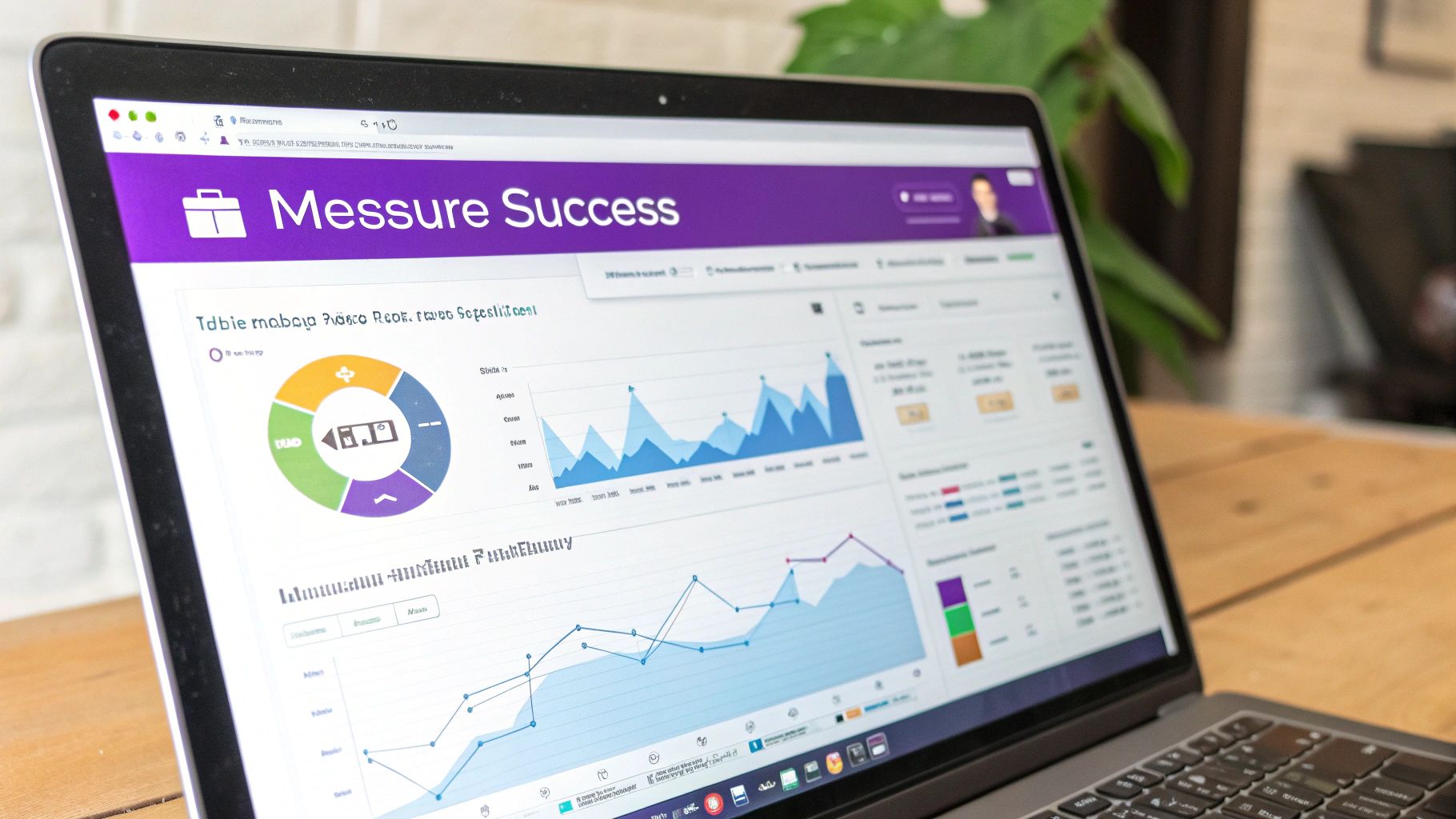
Let's be honest. In hotel marketing, vanity metrics like follower counts and likes are the equivalent of a stunning lobby with no guests checking in. They look nice and feel good, but they don't actually pay the bills. If you want to justify your marketing budget and build a strategy that truly works, you have to look past the popularity contest and focus on profitability.
The real acid test for your social media efforts is simple: is it putting heads in beds? Are your Instagram stories driving people to your booking page? Are those influencer promo codes getting punched in at checkout? Answering these questions is what separates a social media manager from a strategic revenue driver.
Moving Beyond Engagement to Conversions
While engagement—all those likes, comments, and shares—is a decent starting point, it’s certainly not the finish line. The critical next step is to draw a direct line from that online buzz to tangible business results. This is where your analytics tools become your best friend.
Think of it this way: a high engagement rate is like a big crowd of people window-shopping outside your hotel. It’s a great sign of interest. But a high conversion rate means those people are actually walking through the front door and booking a room. Your job is to build a clear, sturdy bridge between the two.
For creators and influencers, this is the key to becoming an invaluable partner. When you can walk into a meeting and show a hotel exactly how many bookings your content generated, you stop being a creative expense and become a proven source of revenue.
The most valuable creators don't just deliver beautiful content; they deliver measurable business results. Proving your ROI is the ultimate way to stand out and command higher rates.
Building Your Revenue-Focused Dashboard
You don’t need an overwhelmingly complex system to track what really matters. You can build a simple, powerful dashboard using free and readily available tools like the platforms' own analytics and Google Analytics.
Start by focusing on these core revenue-centric KPIs:
- Referral Traffic: How many people are clicking from your social media profiles and landing on your booking engine? In Google Analytics, you can find this under Acquisition > Traffic Acquisition. A steady flow here is solid proof that your content is sparking real booking intent.
- Conversion Rate from Social: Of all the visitors who arrive from social media, what percentage actually follow through and make a reservation? If this number is low, it could be a red flag for a clunky booking process or a mismatch between your social posts and your website’s offer.
- Promo Code Redemptions: This is the cleanest, most direct way to track ROI from influencer partnerships. When you give an influencer a unique discount code (like "CREATOR15"), every single use is a directly attributable sale. It's undeniable proof of their impact.
Tracking Performance and Optimizing Your Strategy
Your dashboard isn't a one-and-done project. It's a living, breathing guide that should inform your every move. By checking in on these metrics monthly, you can spot trends and constantly tweak your approach for better results.
For example, maybe you notice that your Instagram Reels showcasing the poolside bar get tons of website clicks but very few actual bookings. Perhaps the call-to-action is the problem. You could test sending people to a dedicated "Poolside Packages" landing page instead of your generic homepage. That's data-driven optimization in action.
Ultimately, you want to create a powerful feedback loop:
- Launch: Post your content or kick off a campaign.
- Measure: Track the key revenue metrics tied to that launch.
- Learn: Dig into the data to see what worked and what flopped.
- Optimize: Apply what you learned to the next campaign.
This continuous cycle is what turns your hotel social media marketing from a simple promotional tool into a predictable, powerful engine for driving direct bookings.
Got Questions? We've Got Answers
When it comes to social media marketing for your hotel, it's easy to get tangled up in the details. You're not just posting pretty pictures; you're trying to drive real business. Let's tackle some of the most common questions hoteliers and creators have.
How Much Should We Actually Spend on Social Media Marketing?
This is probably the first question everyone asks, and the honest answer is: it depends. There’s no magic number. A solid benchmark for most hotels is to dedicate 5% to 15% of your total marketing budget to social media efforts.
Think about where you are in your journey. A brand-new boutique hotel fighting for attention will likely need to invest more heavily upfront, perhaps on the higher end of that range, to fund paid ads and creator collaborations. In contrast, a well-known resort that already gets tons of direct bookings might shift its focus—and budget—more toward nurturing its existing community.
The best advice? Start with a pilot budget you're comfortable with. Track every dollar and see what's bringing in bookings. Then, double down on what works and cut what doesn't.
What’s the Right Way to Handle Negative Comments or Reviews?
Seeing a negative comment pop up can sting, but whatever you do, don't ignore it. Hitting 'delete' or hoping it goes away is the worst move you can make. A public complaint is actually a golden opportunity to show everyone watching just how seriously you take guest satisfaction.
Here’s a simple, proven game plan:
- Respond Publicly, and Fast: Acknowledge their frustration with a quick, professional reply. Something as simple as, “We're so sorry your experience didn't live up to your expectations,” shows you’re paying attention.
- Move It to a Private Channel: Your next move is to take the conversation offline. Add a line like, "Could you please send us a DM with your contact info? Our guest relations manager would like to connect with you personally to make this right."
- Treat It as a Learning Moment: Every piece of feedback is a gift. If you start noticing a pattern—multiple people complaining about slow check-in, for example—you’ve just uncovered a real operational issue that needs fixing.
Are Influencer Stays a Better Bet Than Paid Ads?
This isn't an "either/or" situation. The smartest marketers know they work best when used together. Think of it as a powerful combination—one builds trust, the other guarantees reach.
Influencer partnerships are all about authenticity. When a creator you follow recommends a hotel, it feels like a tip from a trusted friend. That kind of social proof is something a traditional ad just can't buy.
Paid ads, however, give you incredible control and scale. You can put your message directly in front of highly specific groups—say, people who live in a certain city and have shown interest in luxury travel.
The real magic happens when you combine them. Use the beautiful, authentic content from your influencer collaborations as the creative for your paid ad campaigns. You get the genuine feel of a creator's post with the precise targeting of an ad. That’s usually where you'll find the best return on your investment.