


If you're relying heavily on Online Travel Agencies (OTAs), it can feel like you're constantly paying rent to reach your own customers. The single best move for long-term profitability and guest ownership is investing in your own SEO. A solid SEO strategy does more than just get you seen; it turns your website into a powerful, direct booking engine that works for you 24/7.
Why SEO Is Your Hotel's Most Valuable Asset
In the hotel business, visibility is everything. Sure, OTAs offer a shortcut to getting in front of travelers, but that shortcut comes with a hefty price tag. We're talking commissions that often eat up 15% to 30% of every booking. This dependence doesn't just chip away at your profits; it puts a wall between you and your guests.
Good SEO is the perfect antidote. It builds a sustainable pipeline of high-value guests who find you directly, cutting out the expensive middleman.
Today’s travelers use Google for far more than just finding the cheapest room. It’s their go-to for dreaming up vacations, planning itineraries, and discovering unique experiences. They’re searching for hotels with specific amenities, looking for local insights, and seeking out that perfect stay. Each of these searches is a chance for your hotel to show up and be the answer they're looking for.
From OTA Tenant to Direct Booking Landlord
Think of the traffic you get from search engines as a compounding asset. Every blog post you write and every technical fix you implement builds on what you've done before. Over time, this effort steadily grows your website's authority, pulling in more and more direct bookings.
A strong SEO presence allows you to build a direct, more profitable relationship with your guests from their very first search. It's about owning your customer journey, not just renting a spot on someone else's platform.
The data speaks for itself. This infographic breaks down just how powerful organic search is for hotels, highlighting the key metrics that matter.
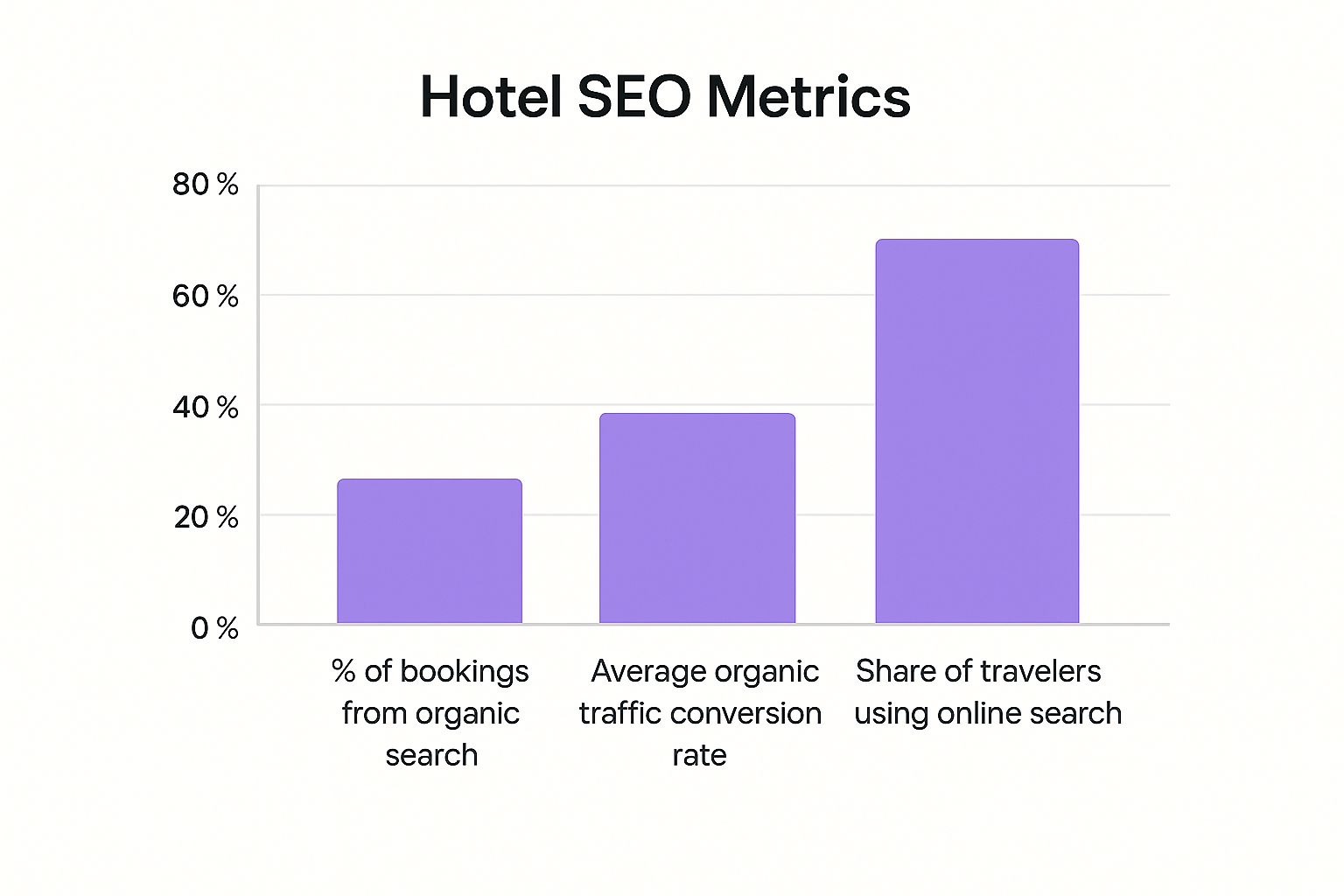
As you can see, a huge chunk of bookings and high-value traffic comes from travelers who are actively searching for what you offer.
The Financial Case: SEO vs. OTAs
When you compare the numbers side-by-side, the advantage of driving your own traffic becomes crystal clear. Relying on OTAs means accepting a permanent cost of sale, whereas SEO is an investment in a long-term, profitable asset.
Let's break down the real-world impact.
Direct Bookings via SEO vs OTA Bookings
| Metric | Direct Booking (via SEO) | OTA Booking |
|---|---|---|
| Guest Acquisition Cost | Low & upfront (SEO investment) | High & recurring (15-30% commission per booking) |
| Profit Margin | Maximized (You keep 100% of the booking value) | Reduced (Commission paid to OTA) |
| Customer Data | Full ownership (Email, preferences, contact info) | Limited or no access (OTA owns the data) |
| Guest Relationship | Direct & personal (Build loyalty from first contact) | Indirect (Mediated by the OTA platform) |
| Upsell Opportunity | High (Direct pre-arrival and on-site communication) | Low to none (Limited by OTA communication rules) |
| Long-Term Value | Compounding asset (Builds brand equity & repeat business) | Transactional (No long-term brand benefit) |
The takeaway here is simple: every direct booking you secure through your SEO efforts is significantly more profitable and strategically valuable than one handed to you by an OTA.
Beyond the Booking: Building Lasting Loyalty
The value of showing up in search doesn't stop once a guest clicks "book." For travelers in 2025 and beyond, search engines are trusted companions throughout their entire journey.
Industry research reveals that a staggering 95% of travelers revisit travel sites after booking their trip, and 74% continue to research their destination. This post-booking window is a golden opportunity. You can upsell spa packages, promote your restaurant, offer local guides, and truly solidify guest loyalty before they even check in.
For a deeper look into this strategy, our complete guide on travel SEO has you covered. This ongoing visibility is how you maximize revenue per guest—a crucial tactic you can explore further with these insightful hotel marketing statistics.
Winning the Neighborhood with Hyper-Local SEO
While a strong website is your foundation, the real booking battle is often won at the neighborhood level. Think about it. Modern travelers aren’t just searching for "hotels in Chicago." They’re getting specific, looking for "hotels near Wrigley Field with free parking" or a "boutique hotel near Millennium Park."
This is where hyper-local SEO becomes your secret weapon. It’s all about moving beyond just existing on Google Maps and becoming the undeniable go-to hotel for your specific corner of the city, dominating the "near me" searches that happen on phones every single second.
Go Beyond a Basic Business Profile
Claiming your Google Business Profile (GBP) is just the first step. Treating it as a set-it-and-forget-it task is a massive missed opportunity. Your GBP is a dynamic, interactive storefront on Google's most valuable real estate: the search results page itself.
Start by optimizing every single field you can. High-quality photos are non-negotiable, but you also need to meticulously list your amenities. Do you have an EV charging station? A pet-friendly policy? A 24-hour fitness center? Get them in there. These details are often the filters a potential guest uses, and if you haven't checked the box, you're effectively invisible.
The Q&A section is another goldmine. Don't wait for people to ask questions; get in there and populate it yourself.
- Anticipate their needs: Think like a traveler. What would they want to know before booking? "What is your check-in time?" "Is there a fee for early check-in?" "How far are you from the convention center?"
- Seed your keywords: Phrase your questions and answers using the exact language your guests use. Instead of a formal "Parking Information," ask, "Do you offer on-site parking for hotel guests?" This directly answers a common search query.
This proactive approach doesn't just help potential guests; it signals to Google that you're an active, helpful, and authoritative local business.
Create Hyper-Focused Landing Pages
A single "location" page on your website just doesn't cut it anymore. To truly capture local intent, you need to create dedicated landing pages for the key attractions and traveler types in your area. This is a core tactic in advanced SEO for the hotel industry.
Think about the main reasons people are traveling to your specific location and build content that speaks directly to them.
Examples of Hyper-Local Landing Pages:
- "Hotel Near the City Convention Center": This page should detail the walking distance, list public transport options, and highlight any business-friendly amenities you offer.
- "Your Perfect Stay for the Annual Music Festival": Target event-goers with info on shuttle services, proximity to the venue, and maybe even a special package.
- "Pet-Friendly Hotel Near Downtown Park": Showcase your pet policies, map out nearby walking trails, and sprinkle in photos of furry guests enjoying their stay.
These pages aren't just for SEO; they are powerful conversion tools. When a traveler lands on a page that speaks directly to their exact need, it builds instant trust and makes the decision to book with you incredibly easy.
This is exactly what the Google Travel interface prioritizes, showing proximity to key landmarks right in the search results.
As you can see, Google prominently features landmarks and neighborhoods, confirming that travelers are searching and filtering based on what's nearby.
Mine Competitor Reviews for Local Gold
Your competitors' reviews are an absolute treasure trove of local keyword intelligence. Guests often leave incredibly specific feedback, revealing precisely what they value and the language they use to describe it.
Spend some time scrolling through the 3-star and 4-star reviews for hotels in your immediate area. Look for patterns and recurring phrases. Are guests constantly mentioning the "quick walk to the arena" or praising the "quiet rooms despite being on a busy street"? Those are your keywords.
Weaving this customer-generated language into your website copy and GBP descriptions ensures you're speaking the same language as your potential guests. A comprehensive approach to localized search is what drives direct bookings. It’s about integrating a perfectly maintained Google Business Profile with hyper-local content on your site.
The biggest win here? Direct bookings generate 100% profit, helping you avoid those painful OTA commissions that can be as high as 30%. You can explore more about how this impacts your bottom line and find other hotel SEO insights on Hotel Tech Report.
Creating Content That Outshines Competitors
Your content is your digital concierge, and in a sea of sameness, you must stand out by selling an experience, not just a room. The generic "Top 10 Things to Do" posts are table stakes. To truly win, you need to create content assets that are so specific and valuable they become a reference point for travelers. This means going beyond simple blog posts and creating immersive content frameworks built around your hotel's unique identity.
Think about what makes your property genuinely different. Is it your award-winning mixology program? Your exclusive partnership with a local art gallery? Your architecturally significant design? These aren't just amenities; they are the pillars of a content strategy designed to attract high-value guests.
Targeting High-Value Travelers with Precision
Forget casting a wide net with broad keywords like "hotel in Chicago." Travelers who are ready to book, especially those willing to spend a bit more, use much more specific, long-tail phrases. These searches signal strong intent and almost always lead to better conversion rates because you’re meeting a very precise need.
You have to think like your ideal guest. They aren't just searching for a place to sleep; they're searching for the perfect trip.
- Amenity-focused searches: "boutique hotel with balcony chicago"
- Experience-driven queries: "miami hotel with rooftop pool party"
- Niche traveler needs: "dog-friendly hotel near Central Park with no pet fee"
- Event-based searches: "hotel within walking distance of the convention center"
These long-tail keywords face less competition and attract guests who are a perfect match for what you offer. When you show up for these searches, making the decision to book directly with you feels like a no-brainer for them.
Building Your Experiential Content Framework
Once you’ve pinpointed what makes you special and who you’re trying to reach, it's time to create content that brings that experience to life. Your goal is to build assets that don't just inform, but actually inspire someone and forge an emotional connection.
This mindset transforms your website from a simple digital brochure into a compelling travel guide, with your hotel right at the heart of the story.
Create Immersive Itinerary Guides
Instead of just listing attractions, weave a full story around a stay at your hotel. Imagine a family planning a weekend getaway. They aren't just looking for a room; they're looking for a seamless, memorable trip.
- A great post title could be: The Ultimate 3-Day Family Weekend in Nashville: A Thompson Hotel Itinerary
- The content itself would map out the entire weekend. It starts with checking into a specific suite, grabbing lunch at your on-site restaurant, and then details nearby family-friendly activities. You’d weave in details like, "After a fun-filled day at the Adventure Science Center, head back for a relaxing swim in our rooftop pool."
Suddenly, your hotel becomes an essential part of the vacation, not just a place to drop their bags.
Develop Unique Experience Landing Pages
If you offer something truly special, it deserves its own dedicated, SEO-optimized page. A single bullet point on your homepage just won't cut it.
- For a hotel with a great spa: Don't just mention it. Create a page for a "Romantic Spa Getaway Package." Detail the treatments, embed a video tour of the spa facilities, and include a direct booking link for that specific package.
- For a pet-friendly property: A page titled "Your Dog's Dream Vacation in Austin" could showcase your pet amenities, feature adorable photos of four-legged guests, and list nearby dog parks and pet-friendly patios.
The secret is creating content that answers a specific traveler's need so completely that they feel like you've personally curated the experience just for them. This level of detail builds tremendous trust and makes booking direct the only logical next step.
Harness the Power of Visual and User-Generated Content (UGC)
Travelers trust other travelers. A real guest's candid photo or video is often far more persuasive than your most polished, professional marketing shot. Actively encouraging and curating user-generated content (UGC) provides a constant stream of social proof that feels authentic and trustworthy.
This is where a strategic approach to creator partnerships pays dividends. Instead of one-off paid posts, build a creator ambassador program. Partner with a select group of travel creators who genuinely align with your brand to produce a library of high-quality, relatable content. Think "day in the life" stories, video room tours, and guides to their favorite local spots near your hotel. This gives you a scalable way to generate authentic marketing assets. For those interested in this model, exploring how to start a UGC agency can offer valuable structural insights.
Integrating this creator-driven content on your website, in email campaigns, and across social channels provides powerful social proof that bridges the gap between browsing and booking.
Technical SEO That Prevents Lost Bookings
While your beautiful content and top-notch local visibility get travelers to your site, a slow, clunky website will send them running—straight to an OTA to book a room. Technical SEO is the engine under the hood. If it’s not firing on all cylinders, you’re losing money every time someone visits your site.
These aren't just minor tweaks; they're the essential fixes that stop you from bleeding potential bookings.
A website that’s slow or a pain to use is a silent booking killer. The foundation of great SEO for the hotel industry is a technically solid website. It has to deliver a seamless experience for both your future guests and the search engine crawlers that rank you.
Don't worry, you don't need to become a web developer overnight. It’s about knowing which technical pieces directly affect your direct bookings and making sure they’re handled.
Master Mobile-First and Slash Page Load Times
Google now operates on a mobile-first indexing system. Plain and simple, this means it ranks your site based on its mobile version. If your mobile site is a clunky, stripped-down afterthought of your desktop site, your rankings are going to take a hit. Period.
Think about your own habits. How long do you wait for a mobile site to load before you just give up? Just a one-second delay can torpedo conversion rates by up to 20%. For a hotel, that's a staggering number of bookings simply disappearing.
Your mission is to make your website lightning-fast, especially on a phone.
- Optimize Your Images: This is the easiest win. You need gorgeous, high-resolution photos, but uncompressed files are absolute speed killers. Use a tool to compress your images before you upload them. You can keep them looking sharp without bogging down the whole site.
- Check Your Booking Engine Speed: Your main website might be fast, but what happens when someone clicks "Book Now"? If that click sends them to a slow, frustrating third-party portal, you've created friction at the most critical moment.
- Minimize Code Bloat: Over time, websites collect junk code from old plugins or retired features. An occasional audit to clean this up can work wonders for your site’s overall speed and health.
Implement Schema Markup for Standout Search Results
Schema markup, also known as structured data, is a type of code you add to your website's backend. A human visitor won't see it, but it gives search engines like Google incredibly detailed information about your hotel.
This is the secret sauce behind those eye-catching "rich snippets" you see in search results—the star ratings, price ranges, and amenity highlights that make a listing jump off the page.
By implementing hotel-specific schema, you are essentially spoon-feeding Google all the information it needs to feature you prominently. This gives you a massive competitive advantage before a user even clicks on your website.
Think of it as pre-qualifying your hotel right there on the search page. A traveler can instantly see your average rating and a price estimate without having to do any extra work.
Essential Schema Types for Hotels
You don't have to be a coding whiz to get this done. Many modern website platforms and plugins have built-in tools to help you add this structured data. Focus on these key types first:
| Schema Type | What It Does | Why It Matters |
|---|---|---|
| Hotel | Defines your business as a hotel, specifying your address, phone number, and name. | This is the foundational schema that tells Google what you are. |
| AggregateRating | Shows your average guest rating (e.g., 4.5 out of 5 stars) from a certain number of reviews. | Builds immediate trust and social proof directly on the search results page. |
| PriceRange | Displays a typical price range for a stay (e.g., "$150 – $300"). | Helps users quickly determine if your hotel fits their budget. |
| HotelRoom | Provides details about specific room types, like "King Suite with Ocean View." | Allows you to appear for very specific, high-intent searches for room types. |
| makesOffer | Communicates real-time room availability and pricing for specific dates. | This is crucial for appearing in Google's dedicated hotel search features. |
Getting these technical elements right is non-negotiable. It’s what ensures all your hard work on content and local SEO actually translates into a fast, helpful user experience—one that leads to more commission-free, direct bookings.
Building Authority with Digital PR and Partnerships

In the world of SEO for the hotel industry, think of high-quality links as the ultimate vote of confidence. When a respected travel blog links to your hotel's website, it's not just a bit of code—it's a powerful digital referral. Every one of these tells Google that your property is a noteworthy destination, helping you build the authority needed to climb the search rankings.
Forget old-school link requests. To stand out, you need to earn links through compelling digital PR and strategic partnerships. This means creating experiences and stories so newsworthy that creators and journalists want to talk about you, generating backlinks that drive both rankings and direct bookings.
Partnering with Travel Creators and Influencers
Effective creator partnerships go beyond offering a free stay for a few Instagram posts. The real value lies in co-creating unique experiences that provide the creator with incredible, exclusive content and give your hotel powerful marketing assets and authentic backlinks.
Instead of a generic comped room, think bigger. Could you co-host a workshop with a creator, like a food photography class with your chef? Or collaborate on a curated city guide, positioning a local creator as your "guest curator" for the month? These activations create a genuine story, not just a sponsored ad.
This approach gives the creator something unique to offer their audience, while your hotel receives high-quality photos, videos, and authentic endorsements from a trusted source. It’s a marketing experience that naturally generates buzz.
How to Identify the Right Creator Partners
The key isn't follower count; it's audience alignment and engagement. A micro-influencer with a highly engaged, niche following is often far more valuable than a macro-influencer with passive viewers.
- Niche Alignment: Seek out creators whose personal brand and audience demographic perfectly match your ideal guest. A luxury wellness retreat should partner with creators in the high-end wellness space, not general travel bloggers.
- Audience Engagement: Look past the likes. Are followers asking genuine questions in the comments? Does the creator respond and foster a community? This indicates a level of trust that can translate into bookings.
- Local Expertise: Partnering with creators who are seen as trusted authorities in your city provides a powerful local endorsement. Their recommendation carries more weight for travelers seeking an authentic experience.
For those interested in the mechanics of these partnerships, our guide on how to become a travel influencer provides valuable perspective on what makes a collaboration truly successful from the creator's point of view.
The most effective partnerships are built on mutual value. You provide a unique, story-worthy experience, and the creator produces compelling content that builds your hotel's authority and desirability—all while giving you a powerful backlink.
Securing Features in Niche Travel Publications
Beyond individual creators, getting your hotel featured in niche travel publications can be an absolute game-changer for your SEO. A single link from a well-respected online travel magazine can be more powerful than dozens of low-quality links combined.
The secret? Give them a story, not a sales pitch. Journalists and editors are bombarded with press releases. What they're really looking for is a fresh, newsworthy angle.
- Develop a Unique Package: Create something that stands out, like a "Digital Detox Weekend" with no in-room TVs and guided meditation, or a "Culinary Masterclass" weekend with your executive chef.
- Host an Exclusive Event: Invite a small, curated group of journalists and local creators to an exclusive preview of your new rooftop bar or a special farm-to-table dinner. An experience is always more memorable than an email.
- Leverage Local Partnerships: Team up with a nearby museum, festival, or popular attraction. Pitch a story about "The Ultimate Arts & Culture Getaway," with your hotel positioned as the perfect home base for the entire experience.
This strategy shifts your outreach from "please feature us" to "here's an interesting story for your readers." It's a proactive approach to public relations that builds genuine media relationships and earns the high-authority links that Google rewards.
Answering Your Hotel SEO Questions
Trying to get your head around SEO can feel like landing in a new city without a map. It’s easy to get lost. Let’s cut through the confusion and tackle some of the most common questions I hear from hoteliers who want to boost their online visibility and drive more direct bookings.
How Long Does SEO Take to Show Results for a Hotel?
This is the big one, isn't it? The honest, no-fluff answer is: it depends, but it's not an overnight fix. Unlike paid ads that give you an instant (and expensive) sugar rush of traffic, SEO is a long-term game. It’s about building a solid foundation that pays dividends for years.
Think of it like planting a garden. You don't get a full bloom the day after you put seeds in the ground. It takes consistent work—watering, weeding, and nurturing—before you see the payoff.
- Months 1-3 (The First Sprouts): You’ll likely start to see some movement for less competitive, long-tail keywords. This is usually the fruit of early on-page optimizations and fixing any glaring technical problems on your site.
- Months 3-6 (Noticeable Growth): This is where things get exciting. Your organic traffic should be climbing, and you'll start ranking for more valuable keywords as your local SEO and content strategy really kick in.
- Months 6-12+ (Significant Impact): Getting to the top for those big, competitive terms like "hotel in Miami" requires sustained effort. Consistent content creation and earning quality backlinks build your authority. This is when you’ll see a real, tangible shift in your direct booking revenue.
The secret ingredient is consistency. Sporadic efforts just don't cut it. A steady, strategic approach is what builds lasting momentum.
Should I Focus on SEO or Just Run Google Ads?
I get this question all the time. The answer isn’t "either/or"—it’s "both/and." SEO and Google Ads are two completely different tools in your marketing toolkit. They work best when they work together, each playing a distinct role.
| Strategy | Primary Goal | Best For |
|---|---|---|
| SEO | Builds long-term organic authority and trust. | Attracting travelers with high booking intent, building brand credibility, and generating a sustainable, low-cost stream of direct bookings. |
| Google Ads (SEM) | Drives immediate, targeted traffic. | Promoting seasonal offers, filling rooms during slow periods, targeting specific events, and getting instant visibility while your SEO gains traction. |
Pro Tip: Running Google Ads is a fantastic way to bridge the gap while your SEO efforts ramp up. The data from your ads—which keywords convert, what ad copy resonates—is pure gold. You can feed those insights directly into your long-term SEO content strategy.
What Is the Most Important Part of Hotel SEO?
If I had to tell you to focus on just one thing, it would be Local SEO. Hands down. While every part of SEO is interconnected, winning in your immediate geographical area provides the most direct and fastest return.
Think about it: most travel searches start with a location. People are searching for "hotels near downtown Denver" or "pet-friendly hotel near me."
When you dominate the local search results, you show up at the exact moment a traveler is ready to book in your city. That means:
- An Obsessively Optimized Google Business Profile: This is your digital storefront. It needs constant love and attention—fresh photos, updated Q&As, and quick responses to every single review.
- Hyper-Local Content: Don't just talk about your hotel; talk about your location. Create pages on your site for things like "our hotel near the convention center" or "the perfect stay for the city's annual jazz festival."
- Consistent Local Citations: Make sure your hotel's name, address, and phone number (NAP) are identical and accurate across all major online directories.
Mastering your own neighborhood puts you right in the path of travelers with high booking intent. It’s the absolute foundation of a successful strategy focused on SEO for the hotel industry.
The game is also changing quickly. With AI becoming more integrated into search, travelers expect instant, hyper-relevant answers. Search engines are acting more like personal travel concierges. This means hotels need to adapt their SEO for voice search, conversational keywords, and content that perfectly matches what a guest is looking for. To get ahead of the curve, you can dive deeper into how these 2025 hotel SEO trends are fueling growth on eventtemple.com.