


Forget the generic advice to "post more consistently" or "find your niche." The path to becoming a paid UGC creator isn't about volume; it's about strategy, quality, and understanding what brands actually want to see. This guide moves beyond surface-level tips to provide a strategic breakdown of powerful user-generated content examples. We're not just showing you what successful content looks like; we're deconstructing it piece by piece to reveal the specific tactics that make it effective and, most importantly, profitable.
For creators looking to stand out in a crowded market, simply producing content isn't enough. You need to create assets that solve a brand's problems, whether that's building trust, explaining a product's value, or driving sales. In this listicle, you will learn how to analyze top-tier UGC, identify the underlying strategies, and apply those same principles to your own work. We'll explore everything from customer testimonials that convert to hashtag campaigns that build massive engagement. Each example is a lesson in how to think like a marketer and create content that gets you noticed and hired. This is your playbook for turning your creative skills into a reliable income stream.
1. Customer Reviews and Testimonials
At the foundation of user-generated content examples lies the humble yet powerful customer review. This form of UGC is a direct line from a user's experience to a potential customer's decision-making process. It involves customers publicly sharing their honest feedback, ratings, and detailed accounts of their interactions with a product, service, or brand. Platforms like Amazon, TripAdvisor, and Yelp have built entire ecosystems around this concept, transforming consumer-to-consumer trust into a primary marketing asset.
For aspiring UGC creators, understanding the mechanics and impact of reviews is crucial. They are the original, unfiltered form of social proof, and their influence on purchasing behavior is immense. Brands actively seek and leverage this content because it provides authentic, third-party validation that traditional advertising struggles to replicate.
Strategic Breakdown
The power of reviews comes from their perceived authenticity. When a customer sees a "Verified Purchase" badge on an Amazon review or a detailed travel story on TripAdvisor, it carries more weight than a polished brand advertisement. This is social proof in its most direct form.
- Trust Signal: Reviews act as a powerful trust signal. High volumes of positive reviews can significantly reduce purchase anxiety for new customers.
- Data Goldmine: For brands, reviews are a goldmine of feedback. They highlight product strengths, reveal unforeseen weaknesses, and provide direct insight into customer language and priorities, which can be used to refine marketing copy and product development.
- SEO Benefits: A steady stream of fresh, relevant reviews provides search engines with new content, often rich with long-tail keywords, which can improve a product or business's local and organic search rankings.
Actionable Takeaways for Creators
To stand out, UGC creators can elevate the standard review format into compelling content. Go beyond a simple star rating and offer a narrative that provides genuine value.
Creator Pro-Tip: Don't just review a product; demonstrate its value in a real-world context. Instead of saying "this travel backpack is great," create a short video showing how you pack it for a 3-day trip, highlighting specific features like the hidden laptop sleeve or water-resistant fabric in action. Frame it as a solution: "How I fit everything for a weekend trip in ONE bag." This transforms a simple testimonial into a valuable, problem-solving piece of content that brands can use as an ad.
This bar chart visualizes two critical metrics that underscore the power of customer reviews in the modern marketplace.
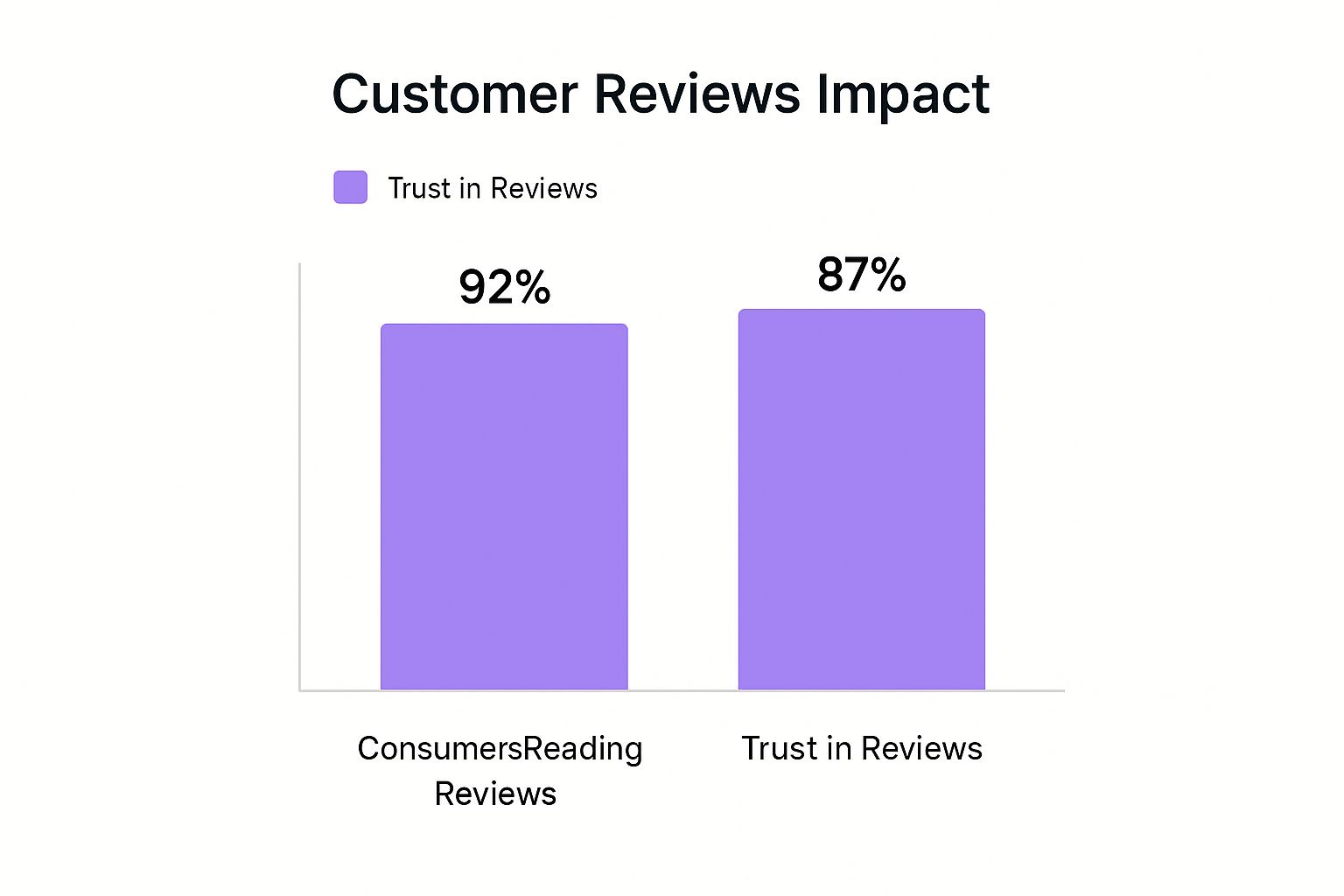
The data clearly indicates that not only do the vast majority of consumers (92%) actively seek out reviews, but a nearly equal percentage (87%) trust them, placing them on par with personal recommendations.
2. Social Media Contests and Hashtag Campaigns
Moving beyond individual feedback, social media contests and hashtag campaigns scale up user-generated content examples by mobilizing an entire community. This strategy involves brands creating a branded hashtag and a compelling call-to-action, encouraging users to create and share content in exchange for a prize, feature, or simple recognition. This approach gamifies content creation, turning brand promotion into a fun, interactive event.
Campaigns like GoPro's ongoing #GoProAwards or Starbucks' annual #RedCupContest have become cultural touchstones, generating millions of pieces of authentic content. These initiatives succeed by providing a clear framework for participation while giving users creative freedom. The result is a massive, searchable library of UGC that showcases the product in countless real-world scenarios, all voluntarily created by an engaged audience.

Strategic Breakdown
The core principle behind a successful hashtag campaign is mutual value exchange. Users get a platform for their creativity and a chance to win something, while the brand receives a tidal wave of authentic marketing assets and increased visibility. It's a powerful engine for building both community and a content portfolio simultaneously.
- Exponential Reach: Each entry shared with the campaign hashtag acts as a personal endorsement, exposing the brand to the user's network. This creates a viral loop that can dramatically expand a campaign's reach far beyond the brand's own followers.
- Content Library: These campaigns are one of the most effective ways to build a diverse library of UGC. A single contest can yield thousands of photos and videos that a brand can repurpose (with permission) across its marketing channels for months.
- Community Building: A shared hashtag creates a digital gathering place. Participants can see what others are creating, fostering a sense of community and friendly competition around the brand, strengthening customer loyalty. This is especially effective in the hospitality sector, where hotels can build vibrant online communities. You can learn more about how travel brands leverage these strategies in hotel social media marketing.
Actionable Takeaways for Creators
To win at hashtag contests, creators must go beyond simply meeting the entry requirements. Success lies in aligning your unique style with the brand's core message while producing content that stops the scroll.
Creator Pro-Tip: Treat a contest entry like a pitch. Research the brand's past winning entries. Identify the visual themes, tones, and storytelling angles they consistently reward. For a #GoProAwards contest, don't just submit a pretty landscape. Instead, create a dynamic reel showing a unique point-of-view (POV) of an adventure, like mounting the camera on your dog or surfboard. This demonstrates not only your technical skill but also your strategic understanding of what the brand values, making your entry stand out to their marketing team.
3. Unboxing Videos and Product Demonstrations
Transitioning from written feedback to visual spectacle, unboxing videos and product demonstrations represent a highly engaging category of user-generated content examples. This format captures a creator’s genuine first impression- from the tactile experience of opening the package to the initial moments of using a product. Platforms like YouTube and TikTok are saturated with this content, as it satisfies audience curiosity and provides an authentic, vicarious experience that heavily influences purchasing decisions.

For creators, unboxing videos are a powerful storytelling tool. They transform a simple product reveal into a narrative of discovery and excitement, a format that brands from Apple to small e-commerce shops actively encourage. The appeal lies in its rawness; the audience gets to see the product through the eyes of a real person, not through a polished brand advertisement. Aspiring creators looking to get started can find excellent guidance on building their presence and attracting brand deals; you can explore how to become an influencer to master these initial steps.
Strategic Breakdown
The magic of an unboxing video is its ability to build anticipation and provide an unfiltered look at a product. It bridges the gap between online shopping and the physical retail experience, allowing viewers to see and almost feel the product before they commit to buying.
- Vicarious Experience: These videos tap into the psychological joy of opening something new. Viewers experience the excitement secondhand, forming an emotional connection to the product.
- Authentic First Look: Unlike scripted ads, unboxings showcase the product exactly as a customer would receive it. This includes the packaging, included accessories, and any initial setup hurdles, providing a transparent and trustworthy overview.
- Feature Showcase: A demonstration goes beyond the initial reveal, showing how a product works in a real-world context. This practical application answers key questions potential buyers may have.
Actionable Takeaways for Creators
To create unboxing content that captures attention and provides real value, focus on the narrative and the sensory details. Move beyond simply opening a box and listing features.
Creator Pro-Tip: Structure your unboxing as a "Problem/Solution" narrative. Start with a hook that identifies a common pain point: "My phone is always dying when I travel." Then, unbox a portable charger and demonstrate in that moment how it solves the problem. Show yourself plugging in your red-battery phone and continuing your day. This connects the product directly to a real-life benefit, providing immense value to both the audience and the brand.
4. Brand Community Forums and Q&A Platforms
Moving beyond individual posts, we find entire ecosystems of user-generated content in brand community forums and Q&A platforms. These are dedicated digital spaces where customers, fans, and experts converge to discuss products, solve problems, and share expertise. This form of UGC transforms passive consumers into active participants, building a powerful, self-sustaining knowledge base and fostering deep brand loyalty. Giants like Apple, Salesforce, and Adobe have cultivated these communities, turning peer-to-peer support into a core asset.
For creators looking to establish authority, these forums are invaluable. Participating and providing genuine help positions you as a knowledgeable expert within a niche. Brands actively monitor these spaces to identify power users and potential collaborators, making them a strategic place to gain visibility and build a reputation based on substance rather than just aesthetics.
Strategic Breakdown
The core value of a brand community is its collaborative nature. Unlike a one-way review, a forum thread is a living conversation that can solve complex issues and reveal nuanced insights. This creates a powerful feedback loop and a scalable support system.
- Reduced Support Costs: When users can find answers from peers, it drastically reduces the burden on official customer service channels. A single answered question can help hundreds or thousands of other users with the same issue.
- Direct Product Insights: These forums are a direct line into the user experience. Brands can observe how their products are used in the real world, identify common pain points, and gather ideas for new features straight from their most engaged customers.
- Fostering Loyalty: A well-managed community makes users feel heard and valued. It creates a sense of belonging and transforms a transactional relationship into an emotional connection with the brand.
Actionable Takeaways for Creators
To leverage these platforms effectively, you must shift from a content creator mindset to a community contributor mindset. The goal is to provide value through expertise and helpfulness.
Creator Pro-Tip: Don't just answer questions; become a "resource creator" within the community. Identify the top 3 most frequently asked questions in a forum. Create a definitive, high-quality video or blog post that answers each one comprehensively. Then, when the question pops up again, share your link as the solution. This establishes you as a go-to expert, drives traffic to your own platforms, and positions you as a valuable potential partner for the brand's education or community team.
5. Photo and Video Sharing Campaigns
Photo and video sharing campaigns are dynamic initiatives where brands prompt their audience to create and share visual content featuring their products, services, or experiences. This strategy transforms customers into active brand storytellers, leveraging the high engagement rates of visual media on platforms like Instagram and TikTok. By creating specific hashtags and clear calls to action, companies like Patagonia and Airbnb have built vast, authentic visual libraries that showcase their offerings in genuine, real-world scenarios.
For aspiring creators, these campaigns represent a prime opportunity to gain visibility and collaborate with top-tier brands. They are more than just a contest; they are an invitation to become part of a brand's narrative. Brands launch these campaigns to generate a steady stream of high-quality, relatable visual assets that resonate far more deeply with audiences than polished, professional advertisements. These visual user-generated content examples are powerful because they are born from genuine user experiences.
Strategic Breakdown
The core strength of a visual sharing campaign lies in its ability to generate authentic storytelling at scale. A photo of a real person enjoying a product or an experience, like someone wearing a Patagonia jacket on a mountain, offers an implicit endorsement that is both powerful and credible. It moves marketing from a brand monologue to a community dialogue.
- Authentic Storytelling: This content provides a raw, unscripted look at a brand's value proposition. It showcases products not in a sterile studio but in the messy, beautiful context of real life, making them more relatable.
- Content Goldmine: Campaigns like these provide brands with a diverse and cost-effective library of visual assets. This content can be repurposed across websites, social media channels, and even in digital ad campaigns, saving significant production costs.
- Community Building: A shared hashtag and theme foster a sense of community among users. Participants feel connected to both the brand and each other, strengthening brand loyalty and creating a tribe of advocates.
Actionable Takeaways for Creators
To truly stand out in a sea of submissions, creators must go beyond a simple product shot. Your goal is to create a visual that tells a compelling story and aligns perfectly with the brand’s core identity and campaign aesthetic.
Creator Pro-Tip: Create a "transformation" visual. Don't just show the result; hint at the before-and-after. For a skincare brand, this could be a split-screen video showing skin texture before and after a 30-day challenge. For a travel company, it could be a quick cut from a boring office desk to an incredible view from a hotel balcony. This storytelling device is incredibly powerful and shows brands you can create content that demonstrates clear, compelling value.
6. Product Customization and Co-creation
Moving beyond feedback, this next category of user-generated content examples involves turning customers into active partners. Product customization and co-creation invite users to design, modify, or personalize products, transforming them from passive consumers into creative collaborators. This model leverages user creativity as the core content, with platforms like Nike By You or LEGO Ideas empowering individuals to bring their unique visions to life.
For UGC creators, this space represents a powerful opportunity to showcase design skills and a unique creative voice. Brands that embrace co-creation are not just selling a product; they are offering an experience and a platform for self-expression. The resulting user-designed items become powerful, tangible pieces of UGC that tell a story of personal investment and brand collaboration.
Strategic Breakdown
Co-creation fosters a deep sense of ownership and loyalty. When a user invests time and creativity into personalizing a product, their connection to that item and the brand intensifies. This is a highly advanced form of engagement that builds a community of advocates.
- Deep Engagement: The act of designing a product is far more engaging than simply making a purchase. It creates a memorable, interactive brand experience that customers are likely to share.
- Organic Marketing: Every customized product is a walking advertisement. A user's unique Nike sneaker or a community-voted LEGO set generates organic buzz and authentic storytelling that traditional marketing cannot buy.
- Product Innovation: Crowdsourcing designs from a community provides brands with invaluable market research and a direct pipeline to innovative, customer-validated ideas, reducing the risk of new product launches.
Actionable Takeaways for Creators
To excel in this niche, creators must position themselves as both designers and storytellers. The goal is to document the creative process and the final outcome in a way that inspires others. This is a valuable skill for creators who might one day consider scaling their operations. If you are interested, you can learn more about starting a UGC agency.
Creator Pro-Tip: Document the "why" behind your design choices. Don't just show your custom Nike shoes. Create a short video explaining the inspiration: "I designed these shoes to match the colors of the sunset on my favorite hiking trail." Then, create a follow-up piece showing you wearing the shoes on that trail. This narrative connects the product to a personal story, making it far more engaging and demonstrating your ability to create emotionally resonant content.
7. Live Streaming and Real-time Interaction
Live streaming introduces an element of spontaneity and immediacy to the world of user-generated content. This format allows creators to broadcast in real-time, fostering a direct, unedited connection with their audience through platforms like Instagram Live, Twitch, and LinkedIn Live. It's a powerful medium for everything from product Q&As and tutorials to behind-the-scenes glimpses and major event coverage.
For creators, live streaming is the ultimate authenticity play. Unlike a polished, pre-recorded video, a live session is raw and interactive, building a strong sense of community and trust. Brands value this form of UGC because it creates a shared, immediate experience, making audiences feel like active participants rather than passive viewers.
Strategic Breakdown
The core value of live streaming is its real-time engagement, which creates a powerful feedback loop between the creator and the audience. This unfiltered interaction makes the content feel more genuine and personal than almost any other format, making it a cornerstone for many modern user-generated content examples.
- Community Building: The interactive nature of live streams, with features like live comments and questions, builds a tight-knit community. Viewers feel heard and valued, strengthening their loyalty to the creator or brand.
- Heightened Urgency (FOMO): Live events are ephemeral, creating a Fear Of Missing Out (FOMO) that drives immediate viewership and engagement. This urgency is difficult to replicate with on-demand content.
- Direct Feedback Channel: Brands and creators can receive instant feedback, answer questions on the spot, and gauge audience sentiment in real-time. This is invaluable for product development, service improvement, and content strategy.
Actionable Takeaways for Creators
To master live streaming, creators must balance preparation with spontaneity. The goal is to facilitate a genuine conversation, not deliver a rigid monologue.
Creator Pro-Tip: Instead of a generic Q&A, host a "Live Audit" or "Workshop" session. Invite a few followers to join you live to solve a specific problem using a brand's product. For example, a home organization creator could help a viewer organize their pantry in real-time using a brand's storage containers. This provides massive value, showcases the product in an authentic use case, and creates compelling content that can be clipped and repurposed later. It positions you as an expert problem-solver, which is exactly what brands want to hire.
By focusing on live, collaborative problem-solving, a creator provides immense value and forges a much deeper connection than a simple Q&A ever could. Repurposing the most insightful moments from these sessions into short-form videos can then extend the content's reach and impact.
7 Key User-Generated Content Examples Comparison
| Content Type | Implementation Complexity | Resource Requirements | Expected Outcomes | Ideal Use Cases | Key Advantages |
|---|---|---|---|---|---|
| Customer Reviews and Testimonials | Low | Minimal (platform tools) | Builds trust, improves SEO, higher conversions | E-commerce, local businesses | Cost-effective, credible social proof |
| Social Media Contests and Hashtags | Medium | Moderate (moderation, prizes) | High engagement, viral reach, user-data | Brand awareness, engagement boosts | Viral potential, community building |
| Unboxing Videos & Product Demos | Medium | Moderate (product samples) | Authentic exposure, strong purchase influence | Tech, beauty, product launches | High shareability, honest insights |
| Brand Community Forums & Q&A | High | High (moderation, management) | Loyal community, reduced support costs | Long-term brand loyalty | Peer support, searchable knowledge |
| Photo & Video Sharing Campaigns | Medium | Moderate (visual assets, curation) | Visual storytelling, increased brand visibility | Visual brands, travel, lifestyle | High visual impact, authentic content |
| Product Customization & Co-creation | High | High (tech, production) | Personalized products, customer loyalty | Custom goods, design-focused brands | Unique products, increased retention |
| Live Streaming & Real-time Interaction | Medium-High | Moderate to High (tech, talent) | Immediate engagement, authentic connection | Product launches, tutorials, Q&A | Real-time feedback, strong engagement |
Your Blueprint for Landing Your Next Paid UGC Deal
The user-generated content examples we've explored throughout this guide are more than just inspiring travel clips or clever unboxing videos. They are strategic assets, meticulously crafted to achieve specific brand goals. For you, the aspiring creator, they are a practical roadmap. Moving beyond generic advice like "post more" is the first step; the real key is to dissect what makes premium UGC truly effective and then systematically apply those principles to your own work. This section distills the core strategies from those examples into a concrete action plan, transforming your understanding into a repeatable process for creating content that brands are actively searching for.
From Examples to Execution: Your Core Takeaways
The most successful creators, those landing consistent, high-value deals, don't just get lucky. They operate like strategic partners. They internalize the frameworks demonstrated in the best user-generated content examples and apply them with precision.
Here are the critical takeaways to integrate into your workflow immediately:
-
Go Beyond the "What," Explain the "Why": Don't just show a beautiful destination or a cool product feature. Articulate the transformation or the solution. Instead of saying "This hotel has a great pool," create content that demonstrates why that pool is the perfect escape for a burnt-out professional or the ultimate fun zone for a family. Brands pay for storytellers who connect features to feelings and benefits.
-
Master the "Hook, Story, Offer" Framework: This classic marketing structure is your best friend. Every piece of content should have a compelling first three seconds (the hook), a narrative that builds interest and trust (the story), and a clear call-to-action (the offer or next step). Analyzing the examples in this article reveals this pattern again and again. It’s a non-negotiable for creating content that converts.
-
Speak the Brand's Language: Before you ever hit record, immerse yourself in the brand's world. Study their website, their ad campaigns, and their social media voice. A brand like Topo Designs, with its rugged, adventurous aesthetic, requires a completely different content style than a luxury wellness retreat. Pitching content that already feels "on-brand" shows you've done your homework and dramatically increases your chances of getting a "yes."
Your Action Plan for Securing Your Next UGC Partnership
Knowledge is only potential power. Action is what secures the bag. Here are the precise steps to take, starting today, to elevate your status from an aspiring creator to a paid professional.
-
Build a "Swipe File" of Excellence: Create a dedicated folder and save the best user-generated content examples you find, especially those within your niche. Don't just save them; analyze them. For each one, write down answers to these questions:
- What is the primary hook?
- What specific problem is this content solving for the viewer?
- How does the creator build trust and authority?
- What is the call-to-action, and how is it presented?
-
Conduct a "Brand-First" Content Sprint: Choose three brands you want to work with. Spend a week creating speculative content tailored for each one. Don't wait for them to hire you. Create the exact type of UGC you would produce if they had, based on your deep-dive analysis. This proactive approach not only sharpens your skills but also provides powerful, hyper-relevant examples for your portfolio and pitches.
-
Refine Your Pitch to Highlight Strategy, Not Just Aesthetics: When you reach out to brands, stop leading with "I love your products and can make pretty videos." Instead, lead with strategy. Frame your pitch around their goals. For example: "I noticed your current campaign focuses on solo female travelers. I've developed a content concept that uses a 'day-in-the-life' format to address common safety concerns, directly aligning with your target audience's needs and building trust."
By shifting your focus from simply creating content to strategically solving brand problems, you fundamentally change your value proposition. You are no longer just another creator with a camera; you are a marketing partner with a proven ability to deliver results. The path to consistent, paid UGC work is paved with this strategic mindset. Now, go build your blueprint.